
Watch crystal is a key factor in determining both the watch's appearance and durability. It's the layer that protects the dial and movement from dust and everyday impacts. Watch crystals vary, ranging from lightweight acrylic, which is easy to polish but prone to scratches, to mineral or tempered glass, which offers a balance between durability and cost, and synthetic sapphire crystal, which excels at scratch resistance but can crack from a direct impact. Choosing the right type depends not only on the material itself but also on the glass's thickness, design, and any coatings added, as well as how you use and care for the watch daily. Understanding these differences will help you choose a watch that truly suits your lifestyle, rather than relying solely on its outward appearance.
What types of watch glass are there?
The watch face, which covers the dial, is made from three main materials, and their names vary from brand to brand. There is no single performance level that applies absolutely to all types. Learn about the characteristics of each type of watch glass and what distinguishes them from the others.
Acrylic or hesalite glass
Acrylic is a transparent plastic material known in some watchmaking contexts by other names such as hesalite, organic glass, or Plexiglas. This type of plastic possesses several practical qualities:
- Lightweight: This makes the watch lighter on the wrist compared to other types.
- Flexibility: It helps to withstand some shocks without cracking as easily as a more rigid material.
- Low cost: makes it a popular choice in a wide range of watch categories.
- Prone to surface scratches: This is the most obvious weakness that appears with daily use.
The flexibility of acrylic does not mean that it is indestructible; some surface scratches can be reduced with proper polishing, while deep scratches or cracks require the entire piece to be replaced.
Metallic or tempered glass
Metallic glass is a silica-based material that undergoes thermal or chemical treatment to increase its resistance compared to ordinary glass. It is sometimes called tempered mineral glass, though the treatment, thickness, and coating vary from one product to another.
- Balance of performance: It offers a combination of scratch resistance and reasonable cost.
- It is not completely scratch-proof: it withstands normal use but does not repel all types of scratches.
- Dealing with damage: When there is a deep scratch or crack, replacement is often the practical solution.
- Treatment variations: The possibility of repairing the glass is determined by its condition and the maintenance equipment available.
synthetic sapphire crystal
The sapphire crystal used in watches is a synthetic material made of crystallized aluminum oxide, not a natural sapphire stone from ornamental stones.
- High scratch resistance: This is one of the most prominent features that distinguishes this type from mineral glass and acrylic.
- Breakable under strong impacts: hardness does not mean absolute durability.
- Edge sensitivity: A strong blow to a particular edge or corner may cause cracking or breaking.
None of these three types can be described as absolutely the best; the choice between them depends on the balance between scratch resistance, shock resistance, weight, cost, and maintenanceability in case of damage.
Differences between scratch and impact resistance in watch glass
Scratch resistance and impact resistance are two completely different properties. The former relates to the ability of the glass surface to withstand friction and surface marks, while the latter relates to the likelihood of cracking or breaking if the watch is subjected to an impact. Understanding the difference between them helps in choosing the right type of watch glass for your usage pattern.
Scratch resistance on the glass surface
Each type of glass differs in its ability to resist scratches resulting from daily use or friction with rough surfaces.
- Acrylic: The most prone to scratching among the three types due to its relatively soft nature.
- Metallic glass: It occupies an intermediate position between acrylic and synthetic sapphire in terms of hardness.
- Synthetic sapphire: It has higher scratch resistance compared to the other two types.
This comparison is general and does not represent a practical guarantee of the performance of a particular item.
Impact resistance and cracking potential
Impact resistance is measured by the ability of glass to withstand blows without cracking or breaking, and is a standard completely independent of scratch resistance.
- Acrylic: Its flexibility gives it the ability to withstand some shocks without breaking easily.
- Metallic glass: It may crack when subjected to a strong blow due to its higher hardness and lower elasticity.
- Synthetic sapphire: Despite its high hardness against scratching, it may also crack upon a strong direct blow.
It is incorrect to link the surface's scratch resistance with its ability to withstand breakage, as these are two completely different things.
Cost and maintenance capability
The possibility of maintenance varies depending on the type of glass and the extent of the damage it is exposed to.
- Acrylic: Some surface scratches can be polished to restore its appearance.
- Metallic glass: When damaged, it often needs to be assessed to determine whether it can be repaired or if replacement is necessary.
- Synthetic sapphire: It follows the same logic; major damage necessitates replacing the piece rather than repairing it.
It should be noted that other factors such as thickness, shape, coatings, watch design and how it is used daily all affect the actual performance of the glass, and the general descriptions here do not represent the result of a standardized test for each piece.
The meaning of the word "crystal" in the watch
In the world of watches, the word "crystal" doesn't refer to a specific material, but rather to the transparent covering that protects the dial and allows the time to be read. Understanding this meaning is essential when researching watch glass types and distinguishing between the various materials used in watchmaking.
Crystal clock face
When a watch is described as having a "crystal," it means there's a transparent cover over the dial, but it doesn't specify the exact material this cover is made of. It could be regular glass, tempered glass, or synthetic sapphire, each with its own hardness and scratch resistance. Therefore, it's incorrect to assume that the word "crystal" in a watch description automatically means it has a sapphire crystal; the watch face could be made of a completely different material.
Synthetic sapphires and ornamental stones
It is important to distinguish between synthetic sapphire crystal used as a watch face material and crystal stones used for decorative purposes on a watch or bracelet. These are two completely different terms in terms of function and composition, and should not be confused with or considered the same thing.
To confirm the actual material of the watch face, it is advisable to consult the written specifications, the accompanying manual, or the watch's reference number. You can also verify this by directly asking the seller or service center about the material used in the crystal case, ensuring you receive accurate information and avoiding any ambiguity that the word "crystal" alone might suggest.
How do you choose the right watch glass?
Choosing the right watch glass depends on how you use the watch daily, how important scratch or shock resistance is to you, and how keen you are to check the actual glass material rather than relying on generic labels.
Choosing glass based on daily use
Linking the choice to the expected use and your personal preferences is the first step to determining the right type for you.
- Those who prioritize lightness and the ability to polish some surface scratches may prefer acrylic.
- Those looking for a reasonable balance between cost and scratch resistance may consider metallic glass.
- Those who focus primarily on surface scratch resistance may choose synthetic sapphire.
Balancing scratches and impacts
The right choice is not based on just one characteristic, but on understanding the relationship between scratch resistance and impact resistance together.
- High scratch resistance does not automatically mean that the glass withstands strong impacts with the same efficiency.
- The ease with which acrylic can be polished when scratches occur does not mean that all types of damage are repairable in the same way.
- Balancing these two features helps you determine the type that best suits your daily usage.
Checking the specifications of the glass material
A thorough check of the glass material is a necessary step before making a final decision.
- Check the company specifications, the enclosed brochure, or the watch's reference number to confirm the exact material type.
- Check the specific type of material instead of relying on the word “crystal” alone, as this word does not specify the type of glass itself.
- Avoid performing home scratch tests, or pressing or touching glass to determine its type, as these methods may damage the glass, paint, or sealants, and do not give a reliable result when the type of material is unknown in the first place.
Watch glass repair when scratched
The method for treating scratches on watch crystal varies depending on the type of crystal itself; what works for acrylic isn't necessarily suitable for mineral or sapphire. In all cases, avoid using unsuitable abrasives or applying excessive pressure to the surface, as this can cloud or disfigure the crystal instead of repairing it.
Polishing scratches on acrylic glass
Some surface scratches on acrylic glass can be reduced using a polish specifically designed for plastics. However, if the scratches are deep, or if cracks or distortion appear, the best solution is to have the cover replaced at a specialized service center rather than continuing with attempts at home polishing.
Dealing with scratches on metal glass
Polishing metallic glass does not fully restore the surface to its original condition; scratch repair may result in noticeable visual differences or damage to the glass's surface layer. Therefore, replacing metallic glass is the most common and practical option when the damage is visible and noticeable.
Repairing damaged sapphire glass
Due to the high hardness of sapphire glass, any attempt at home polishing is not recommended if it is damaged. The affected piece usually requires careful professional evaluation or complete replacement, as this type of glass requires different handling than other types.
If you notice cracks or breaks in any type of watch glass, or suspect that the watch's sealing has been affected, it is best to go to a service center to accurately assess the condition, rather than continuing to use the watch without prior inspection.
Selected products from Cardial
Cardial offers a diverse selection of luxury and casual watches and accessories for men, women, and children. Its standout feature is the wide variety of products available to suit different tastes and budgets. You'll find models that combine elegance and practicality for everyday wear and special occasions. Browse the following selections to learn more about these products.
Cardinal brand watch
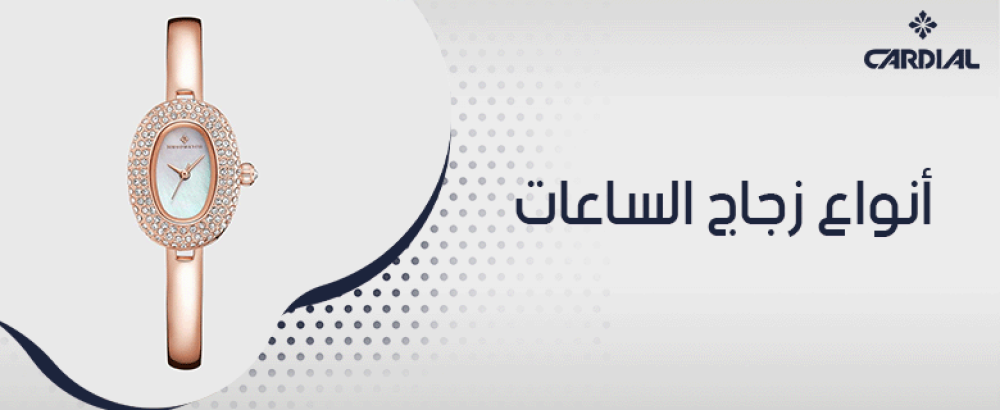
The Cardial brand's Durra watch is a women's watch that combines classic style with modern details, with an oval crystal-studded frame, a pink pearl dial with simple hands, and a metal bracelet with a grooved pattern.
Its soft size makes it suitable for coordinating with both everyday looks and formal occasions, and the version available with a pink dial and silver-tone bracelet appears within the rose gold option.
Hugo Watch Men's Watch 268069
Hugo Watch Men's Watch 268069 Men's watch with a silver case with a geometric shape and rounded corners, a light dial with clear hands and markers and a date window at the 6 o'clock position.
Its elegant design makes it suitable for both formal and casual wear, and the clear time markers and date window on the dial ensure easy time reading. This watch also features a variety of watch crystal types and materials across different models, giving each option its own unique character.
Frequently asked questions about watch glass types
How many types of watch glass are there?
Three main types of watch glass are commonly mentioned: acrylic, mineral glass, and synthetic sapphire crystal. Each type differs in hardness, transparency, and durability, so the choice depends on the watch's intended use.
What is the difference between scratch resistance and breakage resistance?
Scratch resistance refers to the ability of a glass surface to withstand friction and exposure to rough surfaces without showing visible marks. Shatter resistance, on the other hand, refers to its ability to withstand impacts and drops without cracking or breaking. The presence of one property does not necessarily mean that the same glass will possess the other.
Can scratches on a watch glass be polished?
In the case of acrylic glass, minor surface scratches can sometimes be minimized by polishing. However, if the damage is to mineral glass or sapphire crystal, a professional assessment or complete replacement of the glass is often required.
Watch crystals come in a variety of materials, including acrylic, mineral glass, and synthetic sapphire, each offering a different balance of scratch and impact resistance, ease of maintenance, and cost. Always check the material specified in the watch's specifications; don't rely solely on the word "crystal" to determine the type of glass used. Explore the watch designs available at Cardial to find the perfect match for your style and needs.